

Hiking & horseback riding in el Rodeo
The nature reserve is located west of Ciudad Colón
The Zona Protectora ( Nature Reserve) el Rodeo is one of the last large, contiguous forests that once covered the Central Valley.
It is a tropical secondary rainforest that partially merges into a mountain rainforest.
The 2,256 hectare protected area is part of the “ Área de Conservación Pacífico Central ”, i.e. the forests that lie between San José and the Pacific coast.
Even though the last few decades have not left the nature of el Rodeo unscathed with the excessive growth of the population in the central valley, there are still large, connected forests here. The protected area is located in Cantón Mora.
 There are of course some settlements, as well as agriculture, primarily coffee. The nature reserve of el Rodeo is home to over 50 species of mammals and over 150 different species of birds, as well as amphibians and reptiles, some of which are threatened with extinction.
The vegetation consists of medium-high, old-growth tropical forests and secondary forests and represents a transition from the tropical dry forests in Guanacaste to the cloud forests of the Central Valley. The large, tropical tree species commonly found here include the following species:
- The Higuerón , a species of fig tree found only in the tropics of South America from Mexico to the Amazon. The fruit, which looks very similar to the fig we know, is not edible for humans.
The Guayabón is a tree from the winged family, similar to the Guayaba tree and is endemic to this part of Costa Rica. The valuable tropical tree reaches a size of up to 45 m and grows in the immediate vicinity of watercourses.
The Cedro amargo belongs to the mahogany family and is made of very valuable wood. The straight trunk, with a diameter of up to 2 m, reaches a height of up to 40 m. The first branches only grow above the middle of the tree, and the roots are largely located near or above the ground.
The Ceiba pentandra , called Pochote in Costa Rica, or “ kapok tree ” in German, is quite common in the el Rodeo protected area. The kapok tree is a mighty tree, it reaches heights of up to 80 meters and is therefore one of the largest trees in the tropical rainforest. As a young tree it is densely covered with sharp, cone-shaped spines. The trunk is green, the leaves are palmately fingered. They are shed at the beginning of the dry season, starting in November. The fruits are capsules up to 15 cm long that open at the end.
With a bit of luck you can see a lot of animals in the el Rodeo protected area: including the Capuchin and howler monkeys, squirrels, iguanas, anteaters, sloths and armadillos.
On the edge of the protected area is the Universidad de la Paz. From here there are several hiking trails that lead into the protected area.
 Access:
There are several ways to explore the el Rodeo nature reserve:
1. Up on horseback:
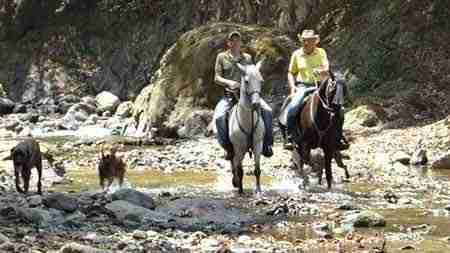
We offer a very individual and exciting day tour through the el Rodeo nature reserve on horseback, with a personal guide. Pure adventure and nature.
2. on foot , from the Universidad de la Paz: